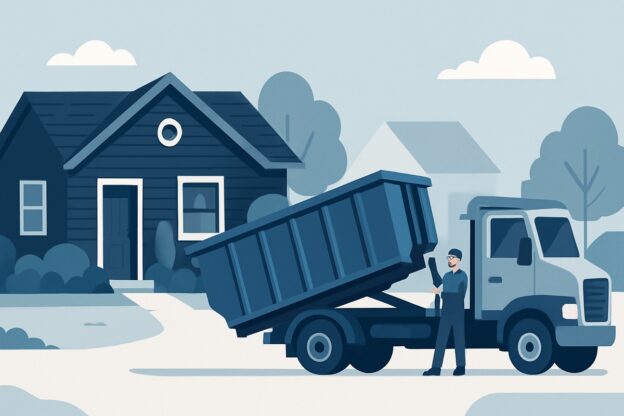
The best place to put a dumpster is on a hard, level surface like a driveway or street where delivery trucks can access it easily, ideally within 60 feet of your project area and away from overhead obstacles like power lines, tree branches, or low-hanging eaves that could interfere with drop-off and pickup.
Get this wrong and you’ll deal with cracked pavement, code violations, or a driver who can’t place the container where you need it—costing you time and potentially extra fees for repositioning. Where to place a dumpster isn’t just about convenience; local regulations often dictate setback distances from property lines, permit requirements for street placement, and surface protection rules that vary significantly by municipality. This guide walks through the practical factors that determine good placement—clearance requirements, surface considerations, permit triggers, and how to avoid the common mistakes that turn a simple rental into a headache.
Renting a Dumpster for This Project?
For most of these jobs, a roll-off dumpster delivered to your driveway is the simplest, cheapest way to handle the haul. Compare local providers and get a free quote in minutes.
Find Dumpster Rental in Your City →
Surface Requirements for Dumpster Placement
Surface Requirements for Dumpster Placement
A roll-off dumpster requires a firm, level surface that can support 10,000+ pounds when loaded. Concrete driveways and asphalt parking areas work best. Grass, gravel, and dirt can work temporarily but often sink under weight, making pickup difficult and leaving ruts. Slopes steeper than a few degrees create safety issues and may prevent delivery altogether.
Best Surfaces for Roll-Off Dumpsters
Concrete driveways are ideal — they distribute weight evenly and won’t deform under a fully loaded container. Most residential driveways handle the load fine, though very old concrete with visible cracks may need plywood protection to prevent further damage.
Asphalt comes in second. It holds up well in cooler weather but can soften in summer heat, especially fresh asphalt less than a year old. If you’re placing a dumpster on asphalt during warm months, putting plywood sheets under the wheels prevents indentation. Commercial parking lots with thick asphalt bases rarely have issues.
Compacted gravel works for construction sites and rural properties. The key word is “compacted” — loose stone shifts and creates an unstable base. A layer at least four inches deep over hard-packed earth gives enough stability. Expect some gravel displacement when the dumpster gets picked up, so plan to rake and refill those spots.
Surfaces to Avoid and Why
Grass seems convenient until the dumpster sinks. Even on dry ground, a loaded container concentrates thousands of pounds onto small wheel contact points. You’ll end up with deep ruts that damage irrigation lines, kill the turf, and require regrading. If grass is your only option, lay sheets of plywood (¾-inch minimum) across the entire footprint to spread the weight.
Dirt and mud are worse. Soft ground turns into a swamp after rain, and wheels sink deep enough that tow trucks struggle to extract the dumpster. Delivery drivers often refuse unstable placements outright because stuck containers require special equipment to retrieve. One landscaping project turned a side yard into a 6-inch-deep trench after three weeks with a dumpster on bare soil.
Slopes create rollaways. Anything steeper than a slight grade puts the container at risk of shifting, especially as you load heavy materials that change the center of gravity. Rental companies typically won’t deliver to placements with noticeable inclines — the liability isn’t worth it. If your only flat surface is at the bottom of a sloped driveway, that’s where the dumpster goes.
Clearance and Access Considerations
Roll-off dumpsters need room to arrive, sit, and leave without damaging your property or the delivery truck. You need at least 23 feet of vertical clearance for the truck’s hydraulic arm and 10–12 feet of width for safe maneuvering. Tight spaces cause delivery failures, property damage, and extra fees when the driver has to make a second attempt.
Overhead and Side Clearance Requirements
The delivery truck’s hydraulic system extends upward as it tilts the dumpster into position. Low-hanging branches, power lines, and building overhangs create real problems. Measure the path from street to placement spot — if anything hangs lower than 23 feet, it’s in the way. Trim branches beforehand. If power or telecom lines are too low, you’ll need to choose a different location or have the utility company temporarily raise them (which they rarely do for residential projects).
Side clearance matters more than most people expect. The truck needs 10–12 feet of width to position the dumpster safely. Narrow driveways with fences, parked cars, or landscaping on both sides won’t work. The driver has to align the truck, extend stabilizer legs, and operate the hydraulic arm without hitting obstacles. If your driveway is 9 feet wide with mailboxes and shrubs crowding the edges, the truck physically can’t deliver there. You’ll either need to remove temporary obstacles or place the dumpster somewhere with more room, like the street (with a permit) or a wider section of your property.
Property Line and Municipal Rules
Placing a dumpster near or over property lines requires written permission from adjacent property owners, and municipal codes typically prohibit obstructing sidewalks or right-of-ways without a permit. Most cities require dumpsters to sit at least three feet from property boundaries and maintain minimum clearances from fire hydrants, utility access points, and handicap ramps. Violating these rules can result in fines ranging from $100 to $500 per day in many jurisdictions.
Setback Requirements from Property Boundaries
Municipal codes establish setback distances to prevent disputes between neighbors and maintain clear access for emergency vehicles. A standard requirement calls for positioning your roll-off dumpster at least three feet from any property line, though some residential zones push this to five or even ten feet. These measurements apply to fences, hedges, and other boundary markers—not just surveyed lines.
The placement gets more complex in corner lots or properties with irregular boundaries. If your driveway sits within five feet of a side property line, you may need to choose between obtaining neighbor consent or finding an alternative spot farther from the boundary. Urban rowhouse owners face particular challenges, as driveways often run directly along property lines with minimal setback options.
Sidewalk and Right-of-Way Restrictions
Public right-of-way encompasses more than just the paved sidewalk—it includes the grass strip between sidewalk and street, utility easements, and sometimes extends several feet into what appears to be private property. Placing a dumpster in any right-of-way area without a permit violates most municipal codes, even if the container sits on your own grass.
Cities enforce these rules because blocked sidewalks force pedestrians into streets and create accessibility barriers for wheelchair users and parents with strollers. When a driveway isn’t an option, you’ll need to apply for a temporary right-of-way permit, which costs between $50 and $200 for a two-week period in most municipalities. The permit process requires proof of liability insurance and usually mandates reflective markers or barricades around the container. Some cities flatly prohibit dumpster rental placement in residential rights-of-way regardless of permits, forcing you to use your driveway or backyard exclusively.
Distance Requirements from Utilities and Fire Access
Fire codes mandate specific clearances around hydrants, fire department connections, and designated emergency access lanes. The standard minimum is 15 feet from any fire hydrant, though some jurisdictions require 20 feet. Block a hydrant during a fire emergency, and you’re looking at immediate towing costs plus fines that can exceed $1,000.
Utility access points present similar restrictions. Water shut-off valves, gas meters, electrical transformers, and telecom pedestals need clear access for maintenance crews and emergency responders. A dumpster that prevents technicians from reaching a gas shutoff creates a safety hazard—and liability. Most utility companies require at least a three-foot clearance radius around ground-level equipment. Underground utility lines matter less for surface placement but become critical if you’re considering softer ground that might compress and shift. Call 811 before placing a heavy container anywhere utilities might run below, even on paved surfaces where subsidence could occur.
Common Placement Mistakes to Avoid
The most frequent dumpster placement errors involve blocking access points, underestimating weight impact on surfaces, and ignoring utility lines. Homeowners routinely park roll-off dumpsters too close to garage doors or fence gates they’ll need during projects, place them on grass that becomes a mud pit after one rainstorm, or position them directly over underground sprinkler lines. These mistakes cost time and money when crews have to relocate the container mid-project.
Blocking Your Own Access
You need the dumpster close to your work area, but not so close it traps you. A contractor once placed a 30-yard roll-off directly in front of his garage the day before a concrete pour—then realized his skid steer was inside with no way out. He paid for an emergency move and lost half a day of work.
Before the delivery truck arrives, walk through your typical movement patterns for the project. If you’re tearing out a kitchen, you’ll haul debris through a specific door dozens of times. If that route requires squeezing past the dumpster at an awkward angle, you’ve added unnecessary strain to every single trip. Leave at least four feet of clearance around the paths you’ll use most. Think about vehicle access too—can you still back your truck up to unload materials, or did you just block your own driveway?
Ignoring Underground Utilities
Property owners assume they know where utility lines run, then drop a 10,000-pound dumpster on top of a buried cable junction box. The container itself might not break anything immediately, but the delivery truck’s outriggers can punch through shallow conduit or crack clay sewer pipes. One homeowner placed a dumpster over an irrigation control valve box and didn’t discover the crushed valve until spring when the system wouldn’t turn on.
Call 811 at least two business days before delivery. Utility companies will mark the location of buried lines at no charge—electric, gas, water, sewer, telecom, cable. The spray paint or flags show you exactly where not to place the dumpster. If you’re renting a roll-off dumpster for a renovation, you likely have multiple utilities converging near the house foundation. A placement that looks fine from the surface might sit on a cluster of lines six inches underground.
Choosing Soft or Sloped Ground
Grass looks sturdy until a six-ton loaded dumpster sinks six inches into saturated soil. The rental company can’t pick up a half-buried container without dragging it across your lawn, which tears up sod and potentially damages the unit. Asphalt driveways seem solid, but a fully loaded 20-yard dumpster concentrated on steel feet can leave permanent indentations in hot-weather asphalt or older paving that’s already softening.
Slope causes different problems. A dumpster on even a modest incline—anything over 3 or 4 degrees—can shift position when loaded unevenly. The container won’t roll away, but it can slide enough to pinch against a fence or structure. More practically, throwing heavy debris uphill into a tilted container is exhausting work. Find the most level section of firm ground available, even if it means placing the dumpster slightly farther from your work area. Concrete, compacted gravel, or pavers distribute weight far better than dirt or grass.
Ready to get started?
Find a Dumpster Near You