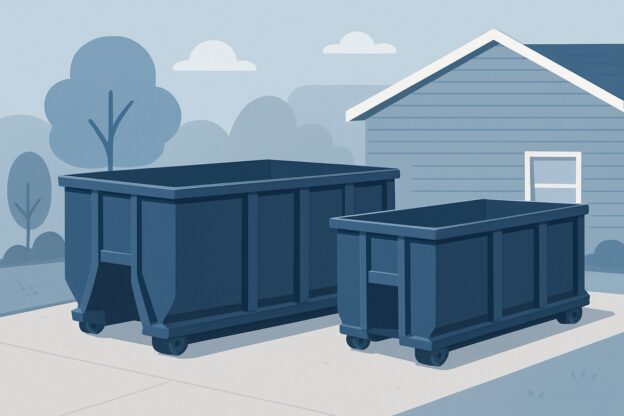
A 15 yard dumpster measures approximately 14 feet long, 7.5 feet wide, and 4.5 feet tall, holding roughly the same volume as four and a half standard pickup truck loads — enough for a moderate bathroom remodel, a large garage cleanout, or replacing the flooring in a 1,500 square foot home. Most people underestimate how much waste even a single-room renovation generates, which is why knowing how big a 15 yard dumpster actually is helps you avoid the frustration of overflowing bins or paying for unused capacity. The difference between a 10 yard and 15 yard often comes down to one extra bathroom’s worth of debris, yet the rental cost gap is usually minimal. This guide breaks down the real-world capacity you can expect, walks through typical projects that fill a 15 yarder to the brim, and shows you how to calculate whether you need to size up or down based on what you’re actually hauling out.
Renting a Dumpster for This Project?
For most of these jobs, a roll-off dumpster delivered to your driveway is the simplest, cheapest way to handle the haul. Compare local providers and get a free quote in minutes.
Find Dumpster Rental in Your City →
15 Yard Dumpster Dimensions and Physical Size
A 15 yard dumpster typically measures 14 feet long, 7.5 feet wide, and 4.5 feet tall. These dimensions create a container roughly the size of a cargo van—compact enough to fit in a standard driveway but large enough to handle major cleanout projects without overwhelming your property.
Standard Length, Width, and Height
Most rental companies stock 15 yard roll-off dumpsters that hold to these measurements within a few inches. The 14-foot length takes up about two standard parking spaces end-to-end. The 7.5-foot width means the container sits comfortably in a single-lane driveway without blocking passage to garage doors or side yards. At 4.5 feet tall, the walls reach roughly chest height on an average adult—low enough to toss debris over the side without a ladder, but tall enough to contain stacked materials.
The open-top design means you can fill the container from above, which matters when you’re disposing of bulky items like furniture or construction debris. Unlike enclosed trailers, you can stand inside a 15 yard dumpster and arrange materials to maximize space. The rectangular shape also stacks efficiently against walls or fences, minimizing the footprint on your property.
Space Needed for Placement
Plan for a placement area at least 50 feet long and 12 feet wide. The extra length beyond the dumpster itself allows the delivery truck to maneuver into position—these trucks need room to extend hydraulic arms and tilt the container onto your driveway or street. The additional width provides clearance so the truck doesn’t scrape siding, fences, or parked cars during delivery and pickup.
Overhead clearance matters as much as ground space. Check for power lines, tree branches, and roof overhangs above the placement spot. Delivery trucks raise the dumpster 20-25 feet in the air when lowering it into position, so a clear vertical path prevents damage to both your property and the equipment. If you’re placing the dumpster in a tight side yard, measure the gate width—most residential gates won’t accommodate a 7.5-foot-wide container, forcing you to use the front driveway instead.
How Much a 15 Yard Dumpster Holds
How Much a 15 Yard Dumpster Holds
A 15 yard dumpster holds 15 cubic yards of material, which equals roughly 4.5 pickup truck loads. Most rental companies set weight limits between 2-3 tons (4,000-6,000 pounds) depending on debris type. The actual amount you can load depends on material density—bulky items like furniture fill the volume before hitting weight limits, while dense materials like concrete or dirt max out weight capacity with space left over.
Debris Volume and Weight Limits
The 15 cubic yard capacity means you’re working with a container that measures approximately 16 feet long, 7.5 feet wide, and 4.5 feet high. Think of it as half the size of a standard parking space with walls reaching mid-chest height on most adults. You can fit about 225 standard 13-gallon trash bags in this space, though mixing different materials changes the equation quickly.
Weight limits matter more than volume for many projects. A dumpster rental contract typically allows 2 tons for mixed debris or household items. Roofing shingles are dense enough that a complete tear-off from a 1,500 square foot roof will hit the weight limit while filling only 60-70% of the container. Soil and concrete projects face even stricter limits—often 1 ton maximum—because these materials compact and concentrate weight at the bottom. Go over the limit and expect overage fees that generally range from $50-100 per ton in 2026. Load heavy materials first, distribute weight evenly across the floor, and stop filling when you reach the top edge. Overfilled roll-off dumpsters can’t be safely transported, which means either hand-removing excess debris or paying additional fees.
What Projects Fit a 15 Yard Dumpster
A 15 yard dumpster handles mid-sized residential projects that generate 3-6 pickup truck loads of debris. You can use one for full-room remodels, large cleanouts, small deck removals, or moderate landscaping jobs. It’s the right size when you’re tearing out more than a bathroom but less than an entire floor of a house.
Bathroom and Kitchen Remodels
Gutting a single bathroom or kitchen generates enough debris to fill a 15 yard dumpster about halfway. You’ll be tossing old cabinets, countertops, flooring, drywall, and fixtures — materials that take up space even after you break them down. If you’re replacing a tub-shower combo with tile work, the old unit alone occupies significant volume once you remove the surround panels and framing.
A full kitchen remodel with cabinet replacement, countertop removal, and appliance disposal will nearly fill the container. Factor in packaging from new materials if you’re having them delivered to the job site. The dumpster rental stays onsite throughout the project, so you’re not making dump runs while managing contractor schedules.
Garage and Basement Cleanouts
Clearing out a two-car garage packed with years of accumulated items — old furniture, boxes, tools, sports equipment, and yard supplies — fits comfortably in a 15 yarder. Basements with similar storage loads work the same way. These jobs involve bulky items that don’t compact well, so you’ll need the extra capacity even if the actual weight stays moderate.
Estate cleanouts fall into this category too. When clearing a deceased relative’s belongings from a home, you’re often dealing with furniture, clothing, books, kitchen items, and miscellaneous possessions from multiple rooms. A 15 yard roll-off dumpster gives you enough space to work through the property methodically without stopping to arrange disposal mid-project.
Deck and Fence Removal
Removing a 200-300 square foot deck fills most of a 15 yard container. Treated lumber doesn’t compress much, and you’ll have joists, decking boards, railings, and potentially concrete footings to dispose of. Breaking down the boards into manageable lengths helps maximize space, but the volume adds up quickly.
Wooden privacy fences around an average backyard (roughly 150 linear feet) generate a similar amount of debris. You’re pulling posts, rails, and pickets, many of which are weathered and splinter when you try to break them down. Chain-link or vinyl fencing takes up less room, so you might pair that removal with another small project.
Flooring Replacement
Ripping out old flooring from 800-1,200 square feet of space — roughly the main level of a modest home — requires a 15 yard dumpster. Carpet and pad compress reasonably well once you cut them into strips and roll them, but hardwood, laminate, and tile don’t. Removing tile means disposing of both the tile itself and the underlayment, which often comes up in chunks attached to thinset.
Subfloor replacement adds considerable volume. If you’re pulling up damaged plywood or particleboard underneath the finish flooring, plan for the container to fill faster than a simple surface-level removal. Wet or mold-damaged subfloors don’t break down cleanly, creating irregular pieces that waste container space.
Roofing Projects for Small Structures
A single layer of asphalt shingles from a small garage (roughly 400-500 square feet) fits in a 15 yarder. Shingle removal generates heavy, compact debris that doesn’t leave much room for additional materials. If you’re also replacing plywood decking or disposing of old gutters and flashing, the container fills to capacity.
Shed or small porch roof replacements work similarly. These structures don’t have the square footage to overload the container, but the weight adds up. Roofing debris settles densely at the bottom, so you won’t get the same volume capacity you would with lighter demolition materials.
Comparing 15 Yard to Other Dumpster Sizes
A 15 yard dumpster sits in the middle of the residential sizing range—larger than the compact 10 yard option but more maneuverable than the bulkier 20 and 30 yard containers. The 15 yard holds roughly 4.5 pickup truck loads of debris, making it about 50% bigger than a 10 yard and half the capacity of a 30 yard. Most rental companies price it $50-$100 less than a 20 yard dumpster, which explains why homeowners working on mid-sized projects often debate between these two sizes.
10 Yard vs 15 Yard: When Smaller Works Better
The 10 yard container works for tightly focused projects—clearing out a basement, replacing a bathroom, or tearing off shingles from a small garage. It takes up less driveway space (roughly 14 feet long versus 16 feet for a 15 yard) and costs $30-$75 less to rent. The tradeoff shows up fast: three tons of weight capacity instead of four, and a container you’ll fill completely during a modest kitchen demo. If you’re removing cabinets, countertops, and flooring from a standard kitchen, the 10 yard fills up. Add in old appliances and drywall, and you’re looking at a second haul or an overage fee.
Choose the smaller roll-off dumpster when your debris estimate feels conservative and your access is tight. A narrow driveway or a project with known, limited scope—say, 800 square feet of old carpet removal—justifies the 10 yard. For anything that might expand or generate more waste than expected, the 15 yard’s extra capacity pays off.
20 Yard vs 15 Yard: The Most Common Decision Point
Most homeowners agonize over this choice because the price difference is minimal—typically $50-$100—while the capacity jump is substantial. A 20 yard holds about six pickup truck loads compared to the 15 yard’s 4.5 loads. That extra 1.5 truck loads translates to roughly 15-20 contractor bags worth of debris, which matters during projects that generate surprise waste. Renovating two bathrooms instead of one, or discovering an extra layer of subflooring during a kitchen remodel, quickly eats up that buffer.
The 20 yard measures about two feet longer (18 feet versus 16 feet) and stands slightly taller, but fits on most residential driveways without issue. Go with the 15 yard when you’re certain about your debris volume and want to save money—removing a deck under 300 square feet, for instance, or handling a controlled garage cleanout. Choose the 20 yard when your project scope includes any uncertainty, when you’re demolishing structural elements, or when you’re working on multiple rooms. Running out of space mid-project and paying for a second dumpster rental costs far more than the initial upgrade.
30 Yard: Double the Capacity, Different Use Cases
A 30 yard container holds twice what a 15 yard does—roughly nine pickup truck loads—and targets whole-house renovations, large estate cleanouts, or new construction projects. At 22 feet long and seven feet tall, it requires significant driveway space and clearance, ruling it out for many residential properties with tight access or overhead obstructions. The price difference ranges from $150-$250 more than a 15 yard, but per-cubic-yard cost actually drops, making it economical for projects that genuinely need the volume.
The real question isn’t whether a 30 yard holds more—obviously it does—but whether your project generates enough continuous debris to justify the footprint and cost. Gutting multiple rooms, removing an entire roof on a 2,000+ square foot home, or clearing out a hoarder house all fit this category. For typical garage cleanouts, single-room remodels, or landscaping projects, a 30 yard sits half-empty while taking up your entire driveway for a week. Match the container to actual debris generation, not to wishful thinking about getting everything done at once.
Part of our Dumpster Sizes Explained: Find the Right Size for Your Home or Commercial Project series.
Ready to get started?
Find a Dumpster Near You