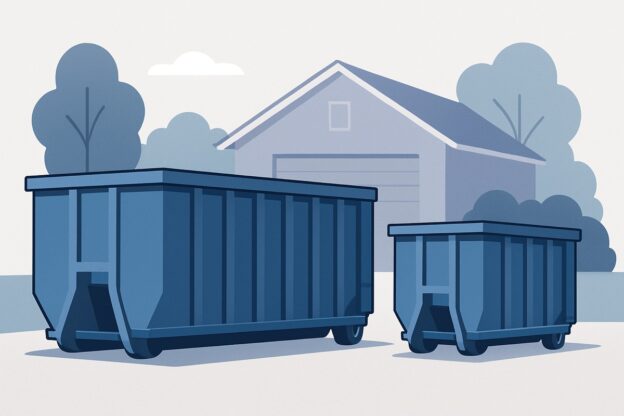
A 12 yard dumpster measures approximately 12 feet long, 8 feet wide, and 4 feet tall, giving you a container about the size of a large pickup truck bed that can hold roughly 72 standard trash bags or the contents of a small garage cleanout. Knowing how big a 12 yard dumpster actually is matters because ordering the wrong size costs you — too small means scheduling a second pickup and paying twice, while too large means wasting money on unused capacity. Most homeowners wildly misjudge volume when they picture debris piled up, which is why half the calls we get involve upsizing mid-project or dealing with overflow fees. This guide breaks down the real-world capacity using familiar reference points, shows you what projects actually fit in 12 yards based on jobsite experience, and walks through the clearance and placement requirements that catch people off guard during delivery.
Renting a Dumpster for This Project?
For most of these jobs, a roll-off dumpster delivered to your driveway is the simplest, cheapest way to handle the haul. Compare local providers and get a free quote in minutes.
Find Dumpster Rental in Your City →
Physical Dimensions of a 12 Yard Dumpster
A 12 yard dumpster typically measures 12 feet long, 8 feet wide, and 4 feet tall. These dimensions create a container that holds roughly the equivalent of four pickup truck loads of debris. The footprint requires about 100 square feet when accounting for door clearance and safe placement, making it small enough for most residential driveways while still handling medium-sized projects.
Standard Length, Width, and Height
Most 12 yard roll-off dumpsters follow industry-standard dimensions, though minor variations exist between rental companies. The 12-foot length runs parallel to the street or driveway when placed, while the 8-foot width extends perpendicular from the curb. The 4-foot height means you can easily toss debris over the side without a ladder, but you’ll want to avoid overloading past the fill line.
The container sits on wheels at one end, raising that side slightly higher than the door end where you’ll load materials. This angled position actually works in your favor — gravity helps material settle toward the back, and you’re not reaching up quite as high when standing at the open end. The sidewalls are solid steel, usually 14-gauge or thicker, and the door swings open to create a walk-in loading area about 6 feet wide.
Space Needed for Placement
Plan for a placement area at least 60 feet long and 10-12 feet wide for safe delivery and pickup. The delivery truck needs roughly 50 feet of straight approach to back the dumpster into position, plus clearance to extend the hydraulic rails and tilt the container down. Width matters because the truck positions itself alongside where the dumpster will sit, then uses an arm to shift it into the final spot.
Overhead clearance creates problems more often than ground space. You need a minimum 23 feet of vertical clearance along the entire delivery path — that means watching for low-hanging utility lines, tree branches, and eaves. A dumpster rental company will refuse delivery if their truck can’t safely maneuver, which typically means rescheduling and potentially paying a trip charge. Measure your driveway approach before ordering, especially the path from the street to your planned placement spot. Tight corners, narrow gates, or steep slopes all complicate delivery, even when the dumpster itself would physically fit in the final location.
What Does 12 Yards Actually Hold
What Does 12 Yards Actually Hold
A 12-yard dumpster holds 12 cubic yards of material, which equals roughly 72 contractor-grade trash bags or the contents of four standard pickup truck beds. Picture a container about 12 feet long, 8 feet wide, and 4 feet tall—large enough to swallow a medium-sized bedroom’s worth of debris but compact enough to fit in a typical driveway without blocking access.
Volume in Practical Terms
Think of cubic yards as stacked boxes. One cubic yard fills a 3-foot cube—about waist-high on most adults. Stack twelve of those cubes, and you get the full capacity of this roll-off dumpster. That translates to roughly 3,000 pounds of mixed debris for most projects, though weight limits vary by material and rental company.
The physical footprint matters as much as volume. A 12-yard container typically occupies about 100 square feet of ground space, similar to parking two compact cars end-to-end. The four-foot height means you can toss debris over the side without a step stool, but you’ll need to break down larger items like furniture or trim branches to maximize space. Fill it strategically—flat materials on the bottom, bulky items broken down and stacked—and you’ll fit significantly more than if you simply toss everything in randomly.
Best Projects for a 12 Yard Dumpster
A 12 yard dumpster works best for medium-sized cleanouts and renovations that generate 3-4 pickup truck loads of debris. Think bathroom remodels, garage cleanouts, small deck removals, or moderate landscaping projects. The container handles jobs too big for curbside pickup but not large enough to justify a 20 yard roll-off dumpster.
Bathroom and Kitchen Remodels
Tearing out a single bathroom generates exactly the volume a 12 yarder can handle. You’ll fill it with the old vanity, toilet, tub or shower surround, tile, drywall, and subflooring. Cabinet removal adds bulk fast — a standard kitchen’s worth of upper and lower cabinets, plus countertops, will take up roughly half the container before you start on anything else.
The real advantage shows up when you’re gutting to the studs. A full bathroom gut (fixtures, tile, drywall, and old plumbing) fits comfortably with room for packaging materials and the inevitable miscellaneous debris. For kitchens, you can typically handle demolition of cabinets, countertops, and one appliance or two, though adding flooring removal might push you toward a larger size.
Garage and Basement Cleanouts
Accumulated junk expands to fill available space, and garages prove this law reliably. A 12 yard dumpster rental handles decades of stored items — old furniture, broken appliances, boxes of forgotten belongings, and yard equipment past its prime. You’re looking at roughly 144 square feet of floor space cleared to a depth of 6 feet, which covers most single-car garages completely.
Basements present a different challenge because you’re moving everything up stairs or through narrow doorways. The physical effort of hauling items up limits how much you’ll realistically remove, making a 12 yarder well-matched to the work. Finished basements with old paneling, drop ceilings, and carpeting fit this size when you’re stripping them down to concrete and studs.
Deck Removal and Replacement
A ground-level deck measuring 12×12 feet or a slightly larger elevated deck (around 10×14 feet) produces enough lumber and fasteners to fill a 12 yard container. Pressure-treated wood is heavy, so the weight limit matters as much as volume — you’ll likely hit the weight cap before the container looks full.
Composite decking weighs less than wood, letting you remove a somewhat larger deck before reaching capacity. Add the railing, stairs, and any lattice skirting, and you’re using every available inch. If you’re also removing the supporting posts and concrete footings, plan on a larger dumpster or a second haul.
Roofing Projects for Small Structures
Shingle removal from a small garage (roughly 400-500 square feet of roof surface) fits a 12 yard dumpster, though you’ll come close to both volume and weight limits. Asphalt shingles are deceptively heavy — a single layer on a 400 square foot roof can weigh 1,200-1,500 pounds, and that’s before you account for the weight of old plywood if you’re replacing decking.
Shed re-roofing works perfectly at this size. You can strip and dispose of shingles from an average storage shed (10×12 or 12×14) with room left for the old ridge cap, drip edge, and damaged sheathing boards. Main house roofing rarely fits — even a small ranch generates too much material for a 12 yarder unless you’re doing a minor repair section.
Yard Waste and Landscaping Projects
Heavy soil, sod, and concrete push weight limits fast, but plant material and lighter debris work well. You can handle brush clearing from a typical suburban lot, removal of several overgrown shrubs, or the pruning waste from 4-5 mature trees. Branches break down more efficiently when cut to 4-foot lengths rather than tossed in whole.
Removing a small patio (8×10 feet of pavers or flagstone) plus the sand base underneath typically fits, assuming you’re not dealing with a thick concrete slab. Fence removal — a standard 6-foot privacy fence running 50-60 linear feet — fills the container when you include posts and concrete footings. The key is knowing that dirt and concrete have a 2-3 times lower volume allowance than most other materials due to weight.
Comparing 12 Yard to Other Dumpster Sizes
A 12 yard dumpster sits in the middle of the residential size range, holding roughly four pickup truck loads of debris. It’s twice the capacity of a 10 yarder but half the size of a 20 yard roll-off dumpster. Most homeowners find it’s the right fit for medium-scale cleanouts or renovations that generate more waste than a few bags but don’t require a full-size construction container.
10 Yard vs 12 Yard: When Two Yards Matter
The jump from 10 to 12 yards translates to about one extra pickup truck load of capacity. A 10 yard dumpster works for tight driveways and small projects like clearing out a garage or replacing a bathroom vanity. You’ll run into space problems if you’re gutting two rooms or tearing out old decking—that’s where the 12 yard shines.
The physical difference matters for placement, too. A 10 yarder typically measures around 14 feet long and 7.5 feet wide, while a 12 yard stretches to roughly 16 feet long. If you’re working with a narrow side yard or a driveway shared with neighbors, those two feet can determine whether the container fits at all.
15 Yard and 20 Yard: Stepping Up in Scale
A 15 yard dumpster adds three more truck loads of capacity compared to a 12 yard. That extra space becomes necessary when you’re dealing with bulkier demolition materials—think removing multiple layers of old roofing or tearing out a kitchen down to the studs. The 15 yard handles full-room remodels where you’re replacing cabinets, countertops, flooring, and drywall in one go.
The 20 yard represents double the capacity of a 12 yard roll-off dumpster and marks the entry point for contractor-scale work. You’d choose this size for whole-home cleanouts, major landscaping overhauls, or renovations spanning multiple rooms. The footprint grows to about 22 feet long, which means you need a full driveway or street parking permit in most neighborhoods. If your project fills a 12 yard container and you’re only halfway done, the 20 yard would have saved you a swap-out fee.
30 Yard and 40 Yard: Commercial Territory
These sizes rarely make sense for typical home projects. A 30 yard dumpster rental holds roughly 180 standard trash bags worth of debris—useful for complete home demolitions, new construction sites, or commercial renovations. The container typically stands around 6 feet tall, which creates challenges for loading without equipment.
A 40 yarder serves large-scale construction projects and commercial property cleanouts. At this size, you’re paying for capacity you won’t use on residential work. The cost difference between a 20 yard and a 40 yard often runs several hundred dollars, and the footprint requires commercial driveway space or street permits that take days to secure. Homeowners working through estate cleanouts or major remodels can almost always complete the job with two 20 yard containers instead of one 40 yard, which provides more flexibility in scheduling and often costs less overall.
Part of our Dumpster Sizes Explained: Find the Right Size for Your Home or Commercial Project series.
Ready to get started?
Find a Dumpster Near You